


01 — The tool
Free musical key detector for MP3 and WAV songs
Song Key Finder analyzes your recording and estimates its major or minor key. The result includes a note name, Camelot code, relative key and neighboring Camelot keys to try. Copy the key into your track notes or download a text report for your music library. The original audio remains available to listen to alongside the result.
A key detector helps with DJ sets, practice and arranging. Some songs change key or have chords that suggest more than one answer. Listen to a clear phrase. Check its chords or bass with an instrument. Open the Camelot Wheel from the result to explore nearby harmonic matches.
02 — How it works
How to find the key of a song online
Upload the recording
Choose a supported MP3, WAV, M4A or FLAC file. Use audio with clear chords, bass or melody. A percussion-only passage may not contain enough pitch information to establish a musical key.
Read the note name and Camelot code
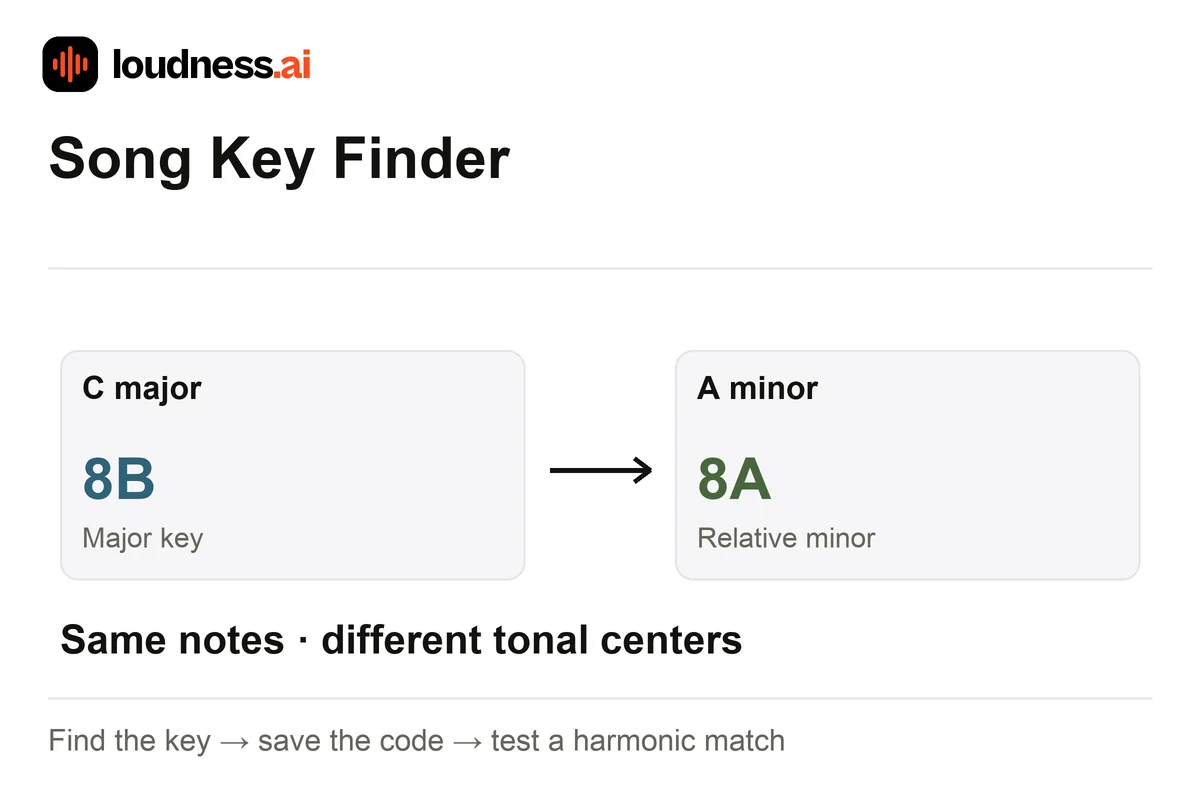
Check whether the result is major or minor. C major is 8B; A minor is 8A. These relative keys share notes, but their tonal centers differ, so compare the result with the music.
Save the result and test a match
Copy the key or download the report. Try a neighboring key or the relative major or minor, then listen to the overlap. Use BPM Finder separately to check tempo before arranging a transition.
03 — Practical uses
Song key detection for DJ sets and musicians
Prepare harmonic DJ transitions
Label tracks with their key and Camelot number. Try a short blend first. Listen to the voices, bass and melody as they overlap. Matching codes can help plan a transition, but they cannot settle every clash between the actual parts playing.
Choose a starting point for practice
Use the detected key to select a scale or chord family to try with the recording. Listen for the resting note and compare more than one phrase before choosing accompaniment.
Arrange a melody in a music project
Find the key before you move or rebuild a melody. Audio to MIDI gives you notes to edit in a music project. Compare their pitches with the source. Then choose an instrument and try the phrase with your new backing.
04 — Frequently asked questions
Song key finder questions
Is Song Key Finder free?
Yes. Upload supported audio, view the estimated key and Camelot code, and copy or download the result for free. Analysis does not transpose or otherwise change your recording.
Does this tool find BPM as well?
This page focuses on musical key and harmonic matches. Use BPM Finder for the recording’s estimated tempo. Tempo measures the pulse rate; key describes its tonal center and major or minor scale.
What do A and B mean in Camelot notation?
A means a minor key and B means a major key. The number identifies its position on the wheel. Matching numbers across A and B indicate relative major and minor keys.
Why might the detected key sound wrong?
Songs can change key or emphasize chords that suggest more than one tonal center. An intro may differ from the chorus. Listen to a representative section and check its sustained notes or chords with an instrument.